
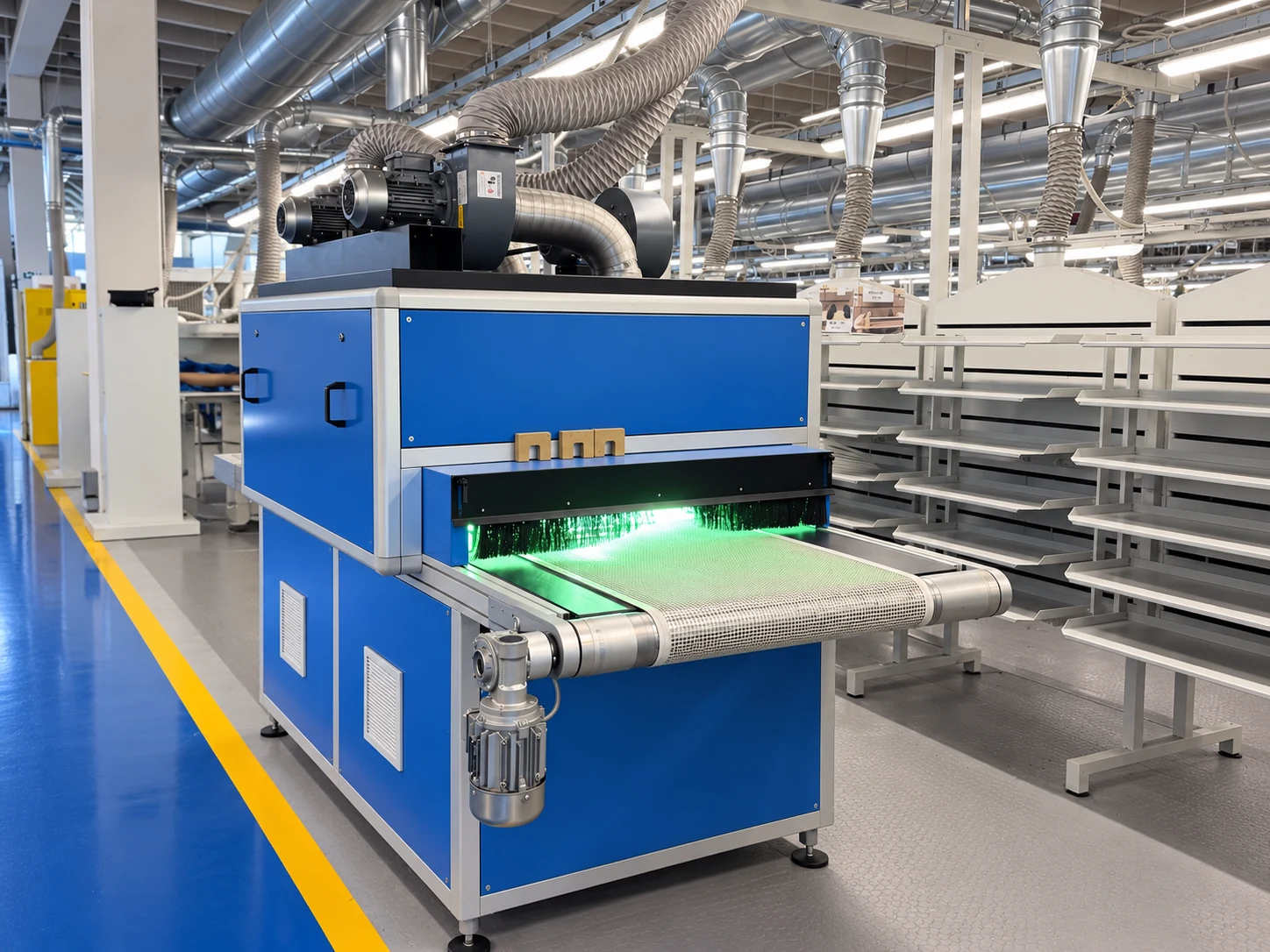
UV Systems for Footwear and Polymer Components
UV systems developed for lines and products that require non-standard solutions: soles, polymer components, shaped surfaces and highly variable production.
Tell us about your projectChallenging products have been one of our most valuable sources of experience.
Our collaboration with Unionprint led us to develop unusual systems starting from the customer's actual requirement: assessment, design and complete manufacture of the UV subsystem.
A solution built around the process.
Shaped products
Positioning and irradiation designed around the actual part.
Integration
Heights, transport, extraction and accessibility are adapted to the machine.
Repeatability
Power, recipes and automation to make the process more stable.
Understand first. Then design.
Observe
We look at the product in production.
Test
We assess how the process behaves.
Adapt
We develop the geometry and control system.
Integrate into the line
Testing on the actual production cycle.
Technology visible in the details.
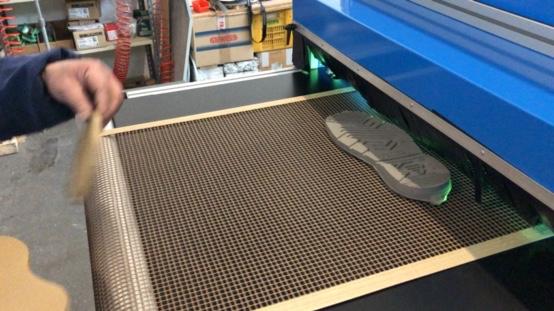
From primer testing to the component's path through the machine.
In 2016, a Rotary UV4 Compact was tested with the customer to verify the treatment of primer on the underside of soles. The photograph documents testing on the actual product.
For primer treatment on slipper straps, a Rotary UV2 Special configuration was instead built with lamps parallel to the conveyor. The comparison shows why two components from the same industry may require different source arrangements.
If your enquiry concerns soles or straps, specify which surface needs treatment and how the part travels through the machine. You can see other examples on the Projects page.
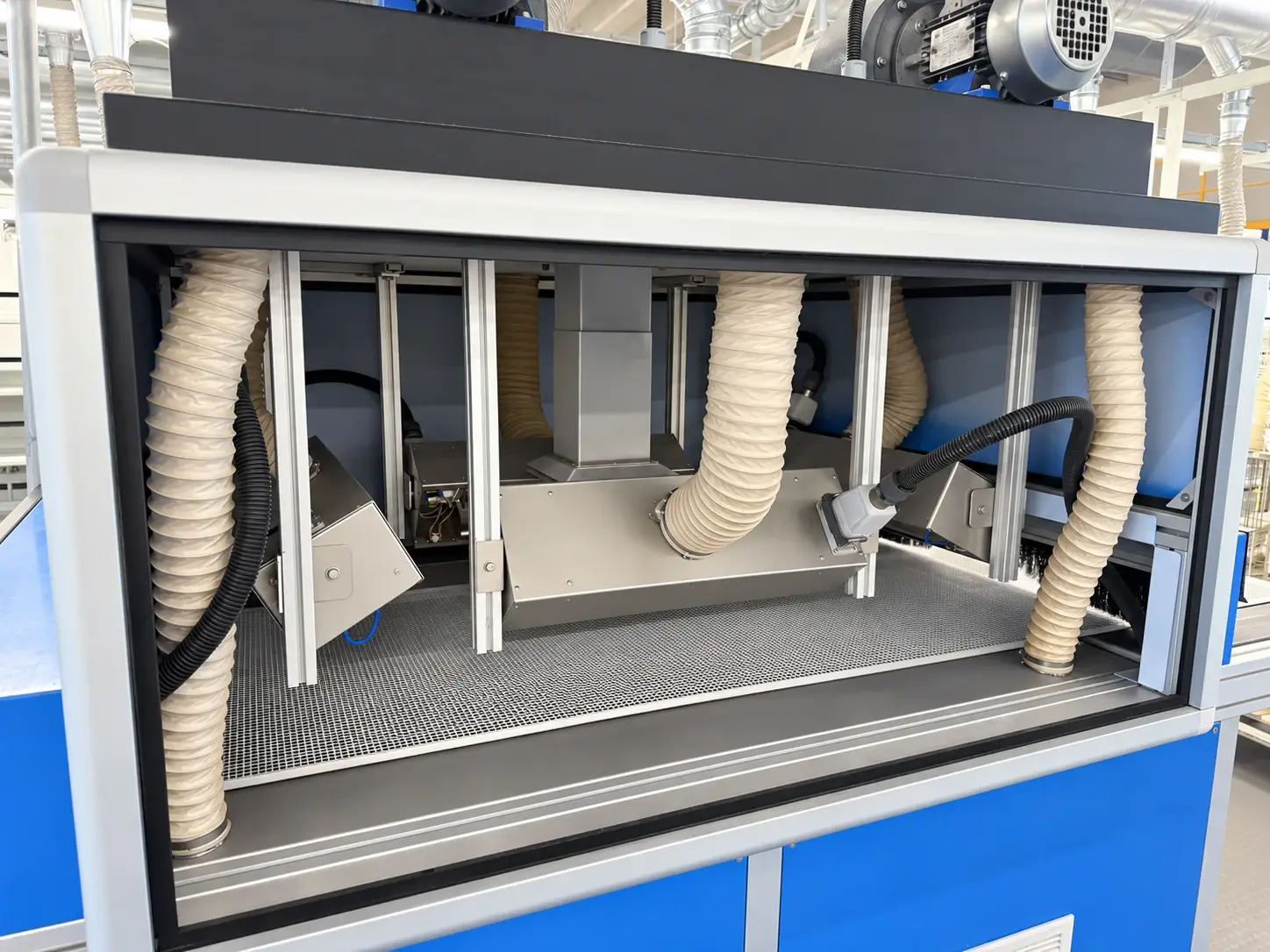
Product transport
Detail of the transport path inside the UV system.
In footwear production, the part's geometry becomes part of the UV design.
On shaped components and materials such as EVA or other polymers, the distance from the source changes as the part passes through. Position, movement and irradiation distribution therefore need to be studied together with the machine.
Positioning
The height, angle and distance of the source are defined according to the component's shape and its actual path through the line, rather than a theoretical flat reference.
Handling
Transport, orientation and part stability directly affect uniformity and repeatability. Where necessary, the mechanical arrangement is adapted to maintain controlled irradiation conditions.
Process and material
The substrate, surface treatment, formulation and permitted temperature need to be considered before choosing the source, power and system geometry.
Useful information: part dimensions, material, orientation on the line, speed, available space, changing distance, formulation and photographs of the relevant machine area.
In footwear production, UV can also mean surface treatment, not only curing.
Materials such as EVA and polymer blends may have low surface energy and require a specific cycle before bonding. Where the process uses UV treatment, the source needs to reach side surfaces, curves and non-coplanar surfaces in a controlled way.
Component orientation, rotation or movement on the conveyor, distance from the lamps, inclination, speed, temperature and extraction therefore become central considerations. Correct geometry may be more important than simply increasing installed power.
Our experience with rotary systems for footwear leads us to design around the actual part: its shape, the side to be treated, stability on the conveyor and integration with upstream and downstream operations.
Machines and controls for the footwear industry
Tell us about the process you want to improve.
We start from your production process, materials and the result you want to achieve. The solution comes afterwards.